
Plants
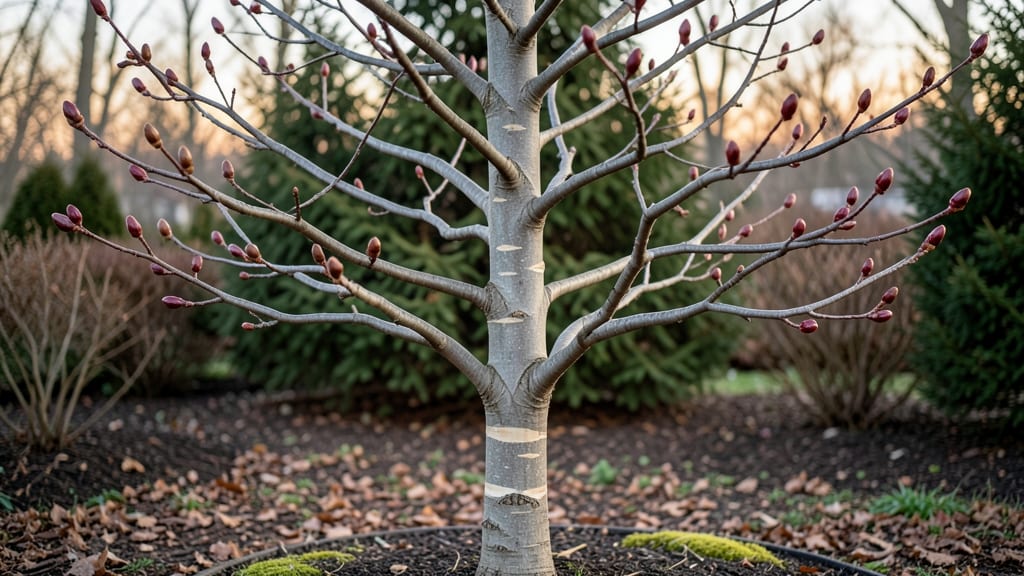
A dogwood tree in winter looks like a sleek, gray-barked beauty with horizontal lenticels, slender branches that zigzag gracefully, and tiny bud scales along the stems. These winter features make it easy to spot even without leaves!
A dogwood tree's winter appearance is all about its smooth, silvery-gray bark and the way its branches grow in zigzag patterns. The horizontal lenticels—those tiny raised lines—stand out like nature's own barcodes, while the bud scales cluster neatly along the branches.
This combination gives it a distinct, almost sculptural look that sets it apart from other winter trees. 🌳 I've found that dogwoods often stand taller and more upright than their leafy neighbors, with branches that seem to dance rather than sprawl.
What really helps with identification is how the bark feels—smooth to the touch, almost like polished stone. Unlike maple or birch, which might have rougher textures or more pronounced ridges, dogwood bark stays consistently smooth.
The zigzag branching is another dead giveaway, creating a rhythmic pattern that's impossible to mistake once you know what to look for.
💡 In This Article
- Identifying Dogwood Bark and Branch Patterns
- Winter Dogwood Tree vs Other Deciduous Species
Identifying dogwood bark and branch patterns
The dogwood's winter bark is one of its most striking features, with a smooth, silvery-gray surface that often develops subtle horizontal lenticels. These tiny, raised pores—about 1/16-inch wide—run parallel to the branch, creating a textured pattern that resembles a series of horizontal stripes.
Unlike birch bark, which has more pronounced diamond-shaped patterns, dogwood bark maintains a consistent smoothness even as it ages, though older trees may develop slight vertical fissures.
What truly sets dogwood branches apart is their distinctive zigzag growth pattern. Each branch segment grows at a slight angle before making a sharp turn, creating a rhythmic, almost geometric design. This pattern is particularly noticeable when viewing the tree from above, where the branches form an intricate lattice.
The buds themselves are another key identifier—small, oval-shaped, and covered with overlapping scales that resemble tiny fish scales, clustered tightly along the stems.
The combination of these features creates a visual signature that's hard to confuse with other trees. For example, maple branches tend to grow more uniformly without the sharp zigzags, while oak branches often have a more rugged, uneven appearance.
The dogwood's slender branches also grow more upright compared to the sprawling habits of many other deciduous trees, giving it a more refined, almost sculptural look in winter.
When examining a dogwood's bark closely, you'll notice how the lenticels create a subtle three-dimensional texture that catches light differently than smoother barks. This texture, combined with the zigzag branching, makes dogwoods stand out in winter landscapes where most trees appear more uniform.
The buds' scale patterns also provide a tactile clue—if you gently rub your fingers along a branch, you'll feel the slightly raised edges of these protective scales.
One interesting botanical detail is how these features serve the tree's survival needs. The lenticels allow gas exchange while preventing excessive water loss, crucial during winter's dry months. The zigzag branching helps distribute weight evenly, preventing branch breakage under snow or ice loads.
These adaptive structures explain why dogwoods maintain their distinctive appearance even in harsh winter conditions.
For those learning to identify dogwoods, I recommend focusing on three key visual cues: the smooth, gray bark with horizontal lenticels; the rhythmic zigzag branching; and the clustered bud scales.
These features work together like a natural fingerprint, making dogwoods one of the most recognizable winter trees once you know what to look for.