
Trees
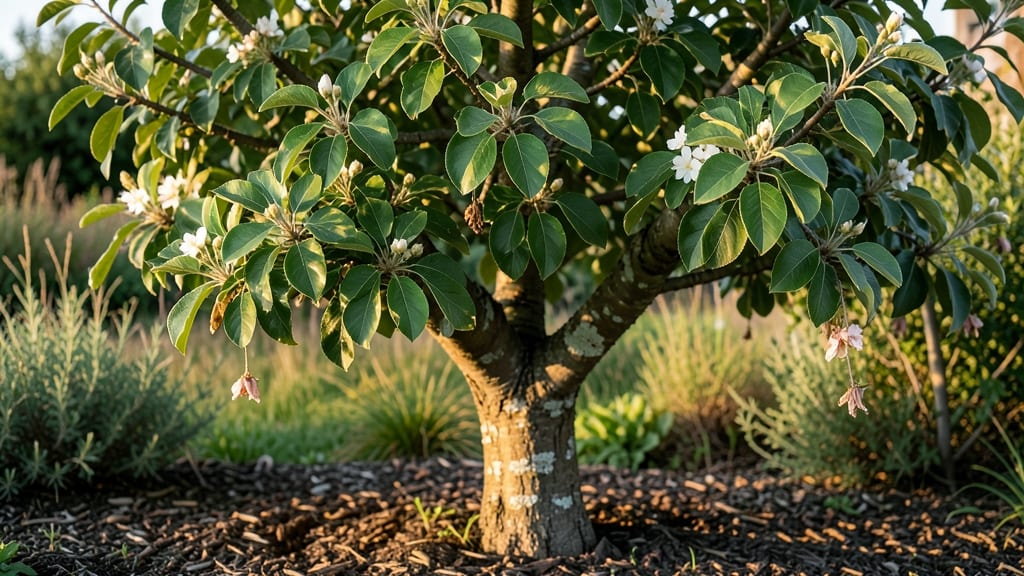
Pear tree leaves look like elongated ovals with a tapered point, jagged edges, and a shiny upper surface paired with a duller underside. They attach singly along branches in a staggered pattern, spanning 2 to 4 inches in length and 1 to 2 inches wide, often with an uneven base.
These leaves stand out from others because of their distinctive serrated edges and the way they grow—never in pairs, always alternating. 🌿 Young leaves emerge a lighter green before deepening to a rich hue, and their glossy texture makes them easy to spot when compared to apple tree leaves, which tend to be more rounded and less glossy.
The asymmetrical base is another key identifier that helps gardeners distinguish them from similar fruit tree foliage.
Understanding these features helps when you're trying to identify a tree in your yard or garden. For example, hawthorn leaves often have more pronounced lobes, while apple leaves are more rounded and less tapered.
Paying attention to these details can save you from misidentifying your trees, especially during spring when new growth is just emerging.
💡 In This Article
- Distinctive Features of Pear Tree Leaves
- Identifying Pear Trees in Your Garden
Distinctive features of pear tree leaves
The oval shape of pear tree leaves is their most defining characteristic, but what makes them truly unique is the asymmetrical base where they attach to the stem. This uneven attachment creates a slightly lopsided appearance when viewed from above, unlike the more symmetrical leaves of apple trees.
The pointed tip often curves slightly downward, adding to their elongated, almost lance-shaped silhouette when fully grown.
The serrated edges are another key identifier—these aren't the deep, jagged lobes of hawthorn leaves, but rather fine, saw-like teeth that run along the entire perimeter. Under magnification, you'd notice these teeth are spaced about 1/8 to 1/4 inch apart, creating a delicate scalloped effect.
The vein pattern features prominent midribs with secondary veins branching out at roughly 45-degree angles, forming a network that's more intricate than apple leaves but less chaotic than walnut leaves.
Color plays a crucial role in identification too. The upper surface is typically a vibrant, glossy green that reflects light, while the underside has a duller, pale green hue. This contrast becomes more pronounced in direct sunlight, where the top appears almost waxy.
Young leaves emerge with a lighter, almost yellow-green tint before maturing to their full color. 🌿 What's fascinating is how this coloration changes with seasons—fall brings golden-yellow or reddish-brown tones before leaves drop, a process influenced by chlorophyll breakdown.
When comparing pear leaves to apple leaves, you'll notice several key differences. Apple leaves tend to be more rounded with softer, less pronounced serrations and a more symmetrical base. The vein patterns in apple leaves also branch at shallower angles, creating a less angular appearance.
Hawthorn leaves, on the other hand, often have more pronounced lobes and a rougher texture that feels almost papery to the touch.
Another distinctive feature is the leaf arrangement—pear tree leaves grow alternately along the branches, meaning each leaf emerges from a different node rather than in pairs. This creates a staggered pattern that's easily visible when looking at a branch.
The leaf size typically ranges from 2 to 4 inches long and 1 to 2 inches wide, though some varieties like the Asian pear may produce slightly smaller leaves.
The texture is another subtle but important clue. Run your fingers gently over a pear leaf—you'll feel a smooth, almost leathery surface on top, while the underside feels slightly rougher due to the more pronounced vein structure.
This texture helps the leaf retain moisture efficiently, which is crucial for the tree's fruit production. 🌱 In comparison, maple leaves often have a more papery feel, and cherry leaves tend to be thinner and more delicate.