
Advice
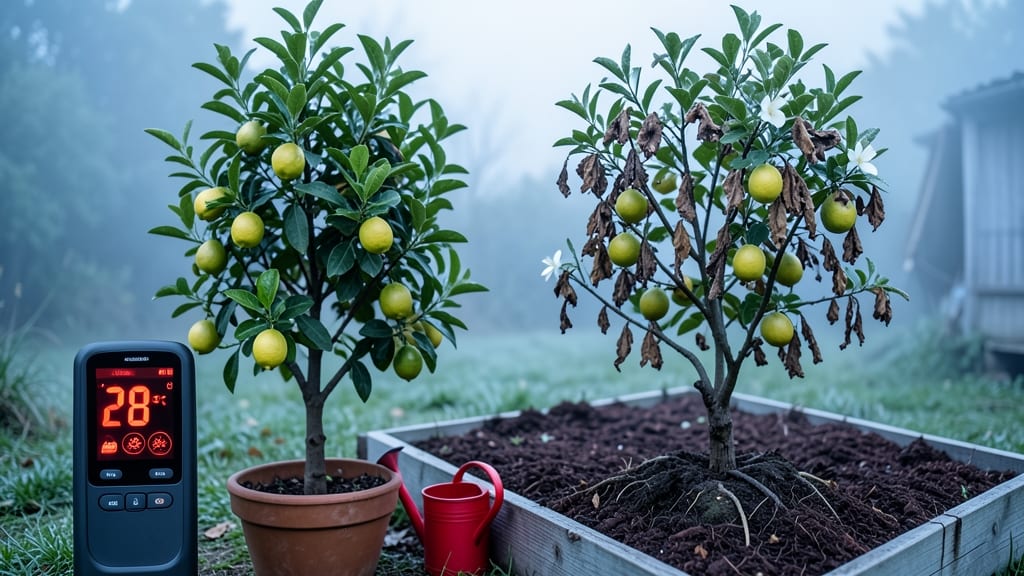
Lemon trees can survive a freeze only if temperatures stay above 20°F (-6°C) for short periods, as prolonged exposure below 28°F (-2°C) causes severe damage or death to most varieties. Cold-hardy varieties like 'Meyer' may tolerate brief dips to 15°F (-9°C).
A lemon tree's ability to handle cold depends on how quickly temperatures drop and how long they stay low. 🌱 When frost lingers below 28°F (-2°C), the tree's cells rupture from ice crystal formation, leading to brown, mushy leaves and even bark splitting.
Even if the top growth appears dead, the roots might still be alive—this is why you should wait until spring to prune damaged branches.
Cold-hardy varieties like 'Meyer' have thicker bark and deeper root systems, which help them recover better from brief cold snaps, but they're still not winter-hardy by any standard.
What makes this tricky is that lemon trees are tropical plants at heart—they thrive in USDA Zones 9-11, where winters rarely drop below freezing.
If you live in a colder zone, you'll need to take proactive steps like wrapping the trunk with bubble wrap or using frost cloths to insulate the tree. Even a few hours of protection can mean the difference between survival and total loss.
💡 In This Article
- Lemon Tree Freeze Damage Thresholds by USDA Hardiness Zones
- Protecting Lemon Trees from Freeze Damage: Practical Prevention Methods
Lemon tree freeze damage thresholds by USDA hardiness zones
When temperatures dip below 28°F (-2°C), lemon tree cells begin to rupture from ice crystal formation—a process called "freeze-induced dehydration."
This damage starts in the leaves and progresses inward, affecting the vascular system that transports water and nutrients. 🌱 The tree's bark acts as a protective layer, but thin-barked varieties like 'Eureka' or 'Lisbon' can split when moisture expands inside the cells during rapid freezing.
Even a single night below 25°F (-4°C) can kill tender new growth, while prolonged exposure below 20°F (-6°C) often leads to complete dieback.
The root system plays a critical role in survival—deeper roots (like those in 'Meyer' lemons) can access warmer soil layers, while shallow-rooted trees suffer more from ground frost. In USDA Zone 9, where winters rarely drop below 20°F (-6°C), lemon trees may experience leaf scorch but often recover.
However, in Zone 8, where temperatures can hit 15°F (-9°C) for short periods, even cold-hardy varieties risk trunk damage. The key difference? Zone 9 trees endure 2-3 hours of cold, while Zone 8 trees face 6+ hours of exposure, accelerating damage.
Here's what happens at each critical temperature:
- 32°F (0°C) and above: Minimal damage; leaves may show frostbite but recover with warmth.
- 28-25°F (-2°C to -4°C): Leaf tissue dies, but trunk and roots often survive if exposure is brief.
- 20-15°F (-6°C to -9°C): Bark cracks, branches die back, and roots weaken—recovery is possible but slow.
- Below 15°F (-9°C): Fatal for most varieties; roots and trunk fail, requiring replacement.
Cold-hardy 'Meyer' lemons have thicker bark and a more robust root structure, allowing them to tolerate 15°F (-9°C) for 1-2 hours—but this is an exception, not the rule. 💛 The real test is how quickly temperatures rise after a freeze.
A rapid thaw can cause additional stress as ice melts and water rushes back into damaged cells, worsening internal damage.
Zone-specific risks vary dramatically: In Zone 10, where freezes are rare, lemon trees thrive year-round, while Zone 9 gardeners must protect trees during unexpected cold snaps. The worst-case scenario? A 3-day freeze below 25°F (-4°C) in Zone 9 can kill a tree outright, even if it's a cold-hardy variety.
This is why monitoring local weather forecasts and preparing protective measures in advance is essential.
What most people overlook is that lemon trees can appear dead after a freeze—brown leaves, brittle branches—but the roots may still be alive.
This is why pruning damaged branches should wait until spring, when new growth signals survival. 🌿 The root system's ability to regenerate is the tree's last line of defense against winter kill.