
Pruning
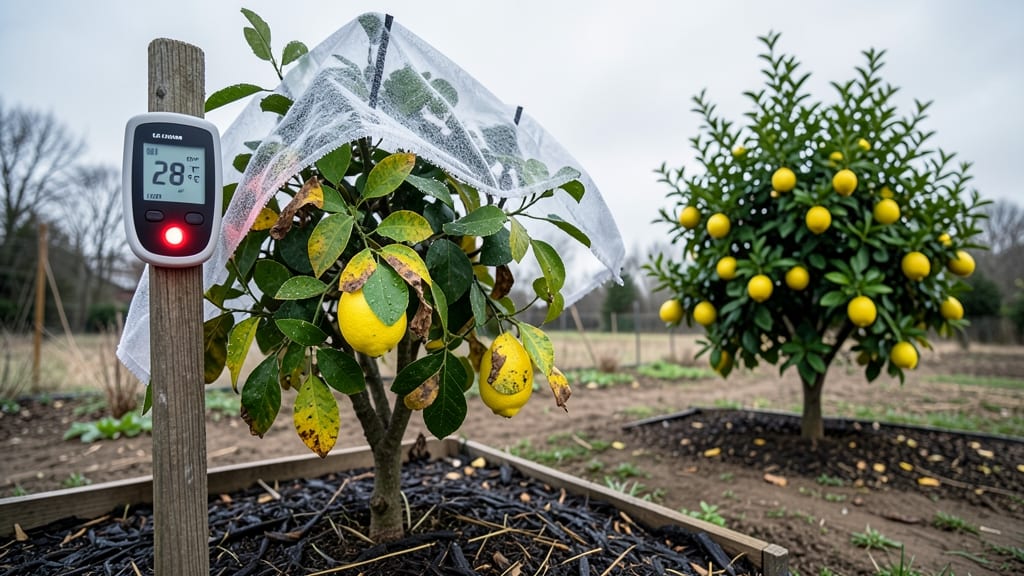
Lemon trees can't survive lemon tree low temperatures below 25°F (-4°C), with leaves blackening and branches dying at 20°F (-7°C). Shield young trees with frost cloth or relocate potted ones indoors before hitting 32°F (0°C). Successful recovery hinges on root condition and careful post-thaw maintenance.
Understanding lemon tree low temperatures reveals why citrus plants struggle in cold climates.
The root systems can endure slightly colder conditions than the canopy—roots may survive down to 20°F (-7°C), but the leaves and branches begin irreversible damage at 25°F (-4°C). 🌱 This is because water in plant cells expands when frozen, rupturing delicate tissues.
Young trees are especially vulnerable because their smaller root systems can't draw enough moisture to protect against freeze injury.
Prevention is key—covering trees with frost cloth or moving potted varieties indoors before temperatures drop below 32°F (0°C) creates a protective barrier. Even mature trees benefit from strategic watering before cold snaps, as moist soil insulates roots better than dry soil.
After a freeze, wait until new growth appears before pruning damaged branches, as this helps the tree redirect energy to recovery.
💡 In This Article
- Lemon Tree Cold Hardiness: Root Zone vs Canopy Damage
- Step-by-Step Lemon Tree Frost Protection Guide
Lemon tree cold hardiness: root zone vs canopy damage
Lemon trees exhibit a fascinating survival paradox where their roots can endure colder temperatures than their foliage. The root zone typically survives down to 20°F (-7°C) because deeper soil retains more heat and moisture, creating a natural insulating barrier.
However, the canopy—leaves, stems, and branches—begins irreversible damage at just 25°F (-4°C). This discrepancy occurs because water in plant cells expands when frozen, rupturing delicate leaf tissues and vascular bundles that transport nutrients.
The cellular damage happens in stages: at 32°F (0°C), growth slows dramatically, but cells remain intact. Between 25°F (-4°C) and 20°F (-7°C), ice crystals form in the extracellular spaces, piercing cell walls and blocking water uptake.
Below 20°F (-7°C), intracellular freezing occurs, causing fatal ruptures in the cytoplasm. Young trees suffer more because their smaller root systems can't draw sufficient moisture to protect against freeze injury, while mature trees have deeper, more established roots that act as thermal anchors. 🌱
Another critical factor is the tree's hydration status before cold snaps. Well-watered trees enter winter with higher moisture content in their cells, which lowers the freezing point slightly (a phenomenon called "osmotic adjustment"). This is why strategic watering in late fall—without over-saturating the soil—can improve cold tolerance by 2-3°F.
The trade-off is balancing moisture retention with frost heave risk, where frozen soil expands and damages roots.
Visual damage often appears as blackened, mushy leaves or brittle branches that snap easily, but the real damage occurs at the microscopic level where cell membranes rupture. Mature trees may lose leaves but regrow from dormant buds, while young trees risk complete dieback if the root collar freezes.
This is why gardeners often prioritize protecting the canopy first with frost cloth, even if roots might survive slightly colder temps.
Consider this comparison: A 5-year-old lemon tree with a 3-inch diameter trunk might survive a 22°F (-6°C) freeze if roots are protected, while a 1-year-old sapling would likely suffer lethal damage at the same temperature.
The difference lies in the tree's ability to store carbohydrates in its roots for energy during recovery—older trees have built up more reserves over time. 💫
Advanced growers sometimes use anti-transpirants (waxy coatings) on leaves to reduce water loss during cold snaps, but these must be applied before temperatures drop below 40°F (4°C). The coating creates a temporary barrier that slows moisture evaporation, giving cells more time to adjust to freezing conditions.
However, this approach requires precise timing—applying too late can trap harmful gases beneath the coating.