
Pruning
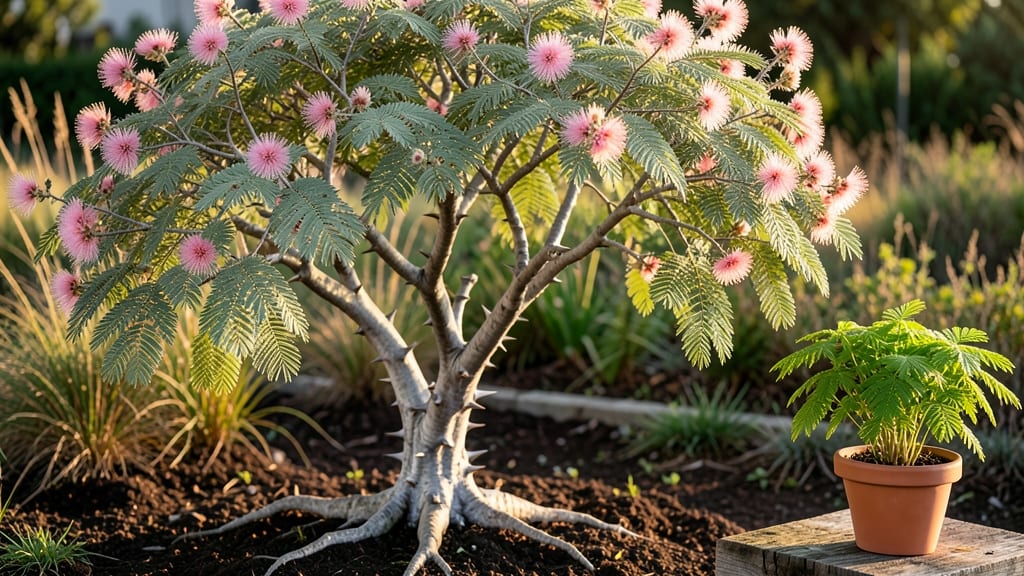
Yes, mimosa trees do have thorns, especially along their branches and stems, serving as a natural defense against animals and human interference. Their sharpness varies by species and age, with types like Albizia being notably prickly.
Mimosa trees develop these sharp spines as a survival tactic—think of them as the plant's built-in security system. 🌿 The thorns protect against deer, rabbits, and even curious pets, while also reducing damage from strong winds or storms.
Younger trees tend to have softer, more flexible thorns, while mature specimens develop thicker, more rigid ones that can actually puncture skin if handled carelessly.
This defensive strategy is particularly pronounced in species like the Albizia, where thorns can grow up to 2 inches long, making them one of the more challenging ornamental trees to work with in landscapes.
Interestingly, these thorns aren't just random growths—they're strategically placed along the tree's main stems and branches, creating a nearly impenetrable barrier. This natural protection explains why mimosa trees thrive in wild landscapes where they face constant browsing pressure.
For gardeners, this means extra caution when pruning or planting near walkways, as even the most experienced hands can end up with painful reminders of their presence! 🌳
💡 In This Article
- Mimosa Tree Thorn Types and Their Defensive Role
- Safely Handling Thorny Mimosa Trees in Landscaping
Mimosa tree thorn types and their defensive role
Mimosa trees deploy two primary types of thorns: stipular thorns and branch thorns. Stipular thorns are small, sharp spines that form at the base of leaf stems, while branch thorns develop directly from the woody stems themselves.
These structures aren't just random—they're evolutionary adaptations designed to deter herbivores by making it physically painful to nibble on leaves or bark. 🌿 The most aggressive thorns appear in species like Albizia julibrissin, where they can reach lengths of up to 2 inches and feature a triangular cross-section, making them particularly effective at puncturing skin.
The sharpness of these thorns increases with the tree's age. Young mimosa trees develop softer, more flexible spines that can bend under pressure, while mature specimens grow thicker, harder thorns that remain rigid even under force. This progression ensures that as the tree grows, its defenses become more formidable.
Scientifically, these thorns act as a form of apical dominance, where the tree prioritizes protecting its most vulnerable growth points—new shoots and leaves—by concentrating thorn density in these areas.
Thorns also play a critical role in the tree's survival during storms. Their rigid structure helps stabilize branches by reducing wind resistance, preventing them from snapping under heavy loads.
This dual-purpose design—defense against animals and structural reinforcement—explains why mimosa trees thrive in both cultivated and wild environments. 🌳 For example, in the southeastern U.S., where deer populations are high, mimosa trees with dense thorn coverage experience significantly less browsing damage compared to their thornless counterparts.
Not all mimosa species are equally armed, however. Some hybrids, particularly those bred for ornamental purposes, have been selectively cultivated to reduce thorn density. These varieties often feature softer, more flexible thorns that are less likely to cause injury, making them safer for residential landscaping.
The trade-off? These trees may require additional protection measures like fencing to deter herbivores.
What makes mimosa thorns particularly interesting is their chemical composition. They contain high levels of silica, a mineral that hardens the thorn structure and makes it more resistant to chewing.
This chemical defense works in tandem with the physical barrier, creating a two-pronged approach that makes mimosa trees nearly impossible for most animals to consume. 💥 In botanical terms, this combination of physical and chemical defenses is known as a "mixed defense strategy," which is why mimosa trees have such high survival rates in their native habitats.
For gardeners, understanding these thorn types helps explain why some mimosa varieties are easier to work with than others. For instance, the Acacia koa hybrid features long, curved thorns that can be particularly hazardous, while the Albizia lebbeck develops shorter, straighter spines that are less likely to cause deep punctures.
Knowing these differences allows for better planning when selecting mimosa trees for specific landscapes or purposes.