
Blooming
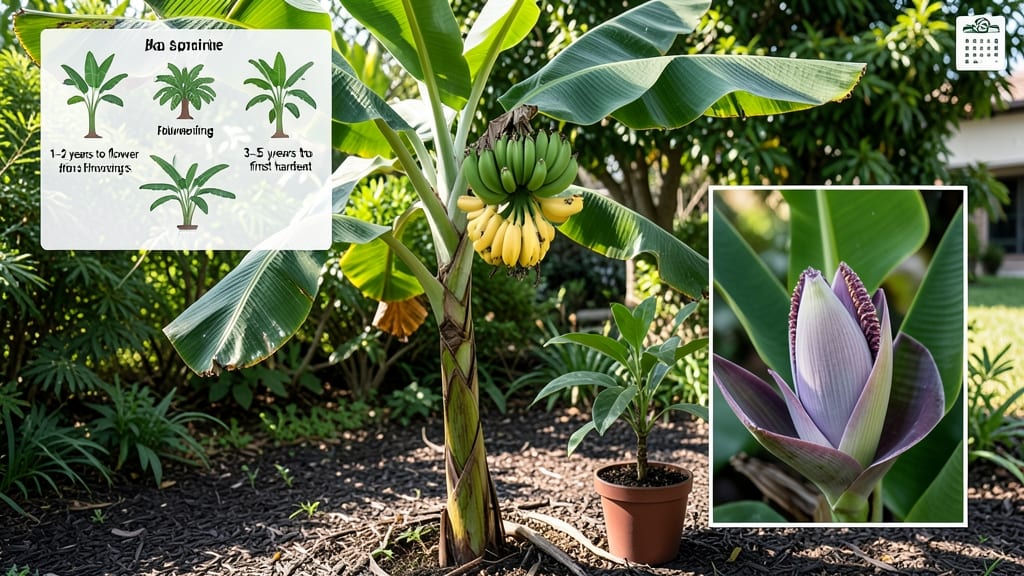
Banana trees typically produce fruit 9 to 12 months after planting, though smaller varieties like ‘Lady Finger’ can bear fruit in as little as 6–9 months, while larger types like ‘Cavendish’ may take 12–18 months before yielding a harvest. The timeline varies based on care and growing conditions.
Timing depends heavily on the banana variety you're growing. 🌱 Smaller, dwarf types like ‘Red Dacca’ often fruit faster because they mature quicker, while commercial varieties like ‘Grand Naine’ need more time to develop their full pseudostem structure.
I’ve seen home gardeners in tropical climates harvest fruit as early as 6 months with proper care, but cooler regions may extend this window significantly. The key is patience—banana trees prioritize leaf and root growth before flowering, so rushing the process can delay fruit production.
Once the tree reaches flowering stage, you’ll notice a long, dramatic bloom that can stretch up to 3 feet—this is your first visual cue that fruit development is underway. 🌿 The flowers themselves aren’t edible, but they’re a fascinating sign of what’s to come.
After flowering, the fruit takes about 3–4 months to fully ripen, depending on temperature and humidity levels. This is why tropical climates often see faster overall production cycles compared to temperate zones.
💡 In This Article
- Banana Tree Growth Stages to First Fruit
- Factors That Speed Up or Delay Banana Harvest
Banana tree growth stages to first fruit
The journey from banana seedling to first fruit involves four distinct growth phases, each with specific timelines. First comes the seedling stage, where the plant focuses on developing a strong root system and initial leaves.
This phase lasts about 3–6 months, during which the tree builds energy reserves for future growth. 🌱 The second phase is pseudostem formation, where the tree grows its iconic false stem (composed of tightly wrapped leaves) and reaches a height of 6–10 feet—this takes another 3–6 months depending on variety and conditions.
What most people don't realize is that banana trees only flower when they've reached a critical size—typically 12–18 months for larger varieties like ‘Cavendish’. The flowering process begins with a dramatic 3-foot-long inflorescence emerging from the center of the plant, which then develops into the banana bunch.
Dwarf varieties like ‘Lady Finger’ can flower as early as 6 months because their genetic makeup prioritizes faster maturation. The final stage is fruit development, where bananas grow from tiny green buds to harvestable size in about 3–4 months, with the ripening process accelerated by ethylene gas production.
Here's what's actually happening during flowering: The tree's hormonal balance shifts dramatically as it transitions from vegetative growth to reproductive mode.
Auxin hormones (growth regulators) decrease while gibberellins increase, triggering the formation of the banana bunch. 🌿 This is why over-fertilizing with nitrogen (which promotes leafy growth) can delay flowering—it keeps the plant focused on foliage instead of fruiting.
The key factor is achieving the right balance between vegetative and reproductive growth phases, which varies by variety.
Consider these key factors when estimating your timeline:
- Genetic makeup: ‘Musa acuminata’ varieties (like ‘Grand Naine’) take longer (12–18 months) than ‘Musa balbisiana’ hybrids (6–12 months)
- Climate conditions: Tropical zones (75–85°F) accelerate growth by 20–30% compared to cooler regions
- Water availability: Consistent moisture (1–1.5 inches weekly) speeds up pseudostem development by 1–2 months
The ripening process itself is fascinating—bananas start green because they produce chlorophyll, but as they ripen, chlorophyll breaks down and carotenoids (orange pigments) take over.
This color change coincides with starch converting to sugars, making them sweeter. 🍌 What's particularly interesting is that each hand (cluster) of bananas ripens at slightly different rates, which is why you'll often see some bananas ready while others remain firm.
For home growers, the most critical observation point is when the first male flowers appear—these are the small, non-edible flowers at the top of the bunch. Once these appear, you have about 2–3 months until the bananas reach harvest size.
This is your best indicator that fruiting is imminent, regardless of the variety you're growing.